In April 1920 in New York, the eminent Dutch poet Louis Couperus wrote in a foreword to the Kartini letters about the mystery of Java: “There was a quiet strength, “Een Stille Kracht” unperceived by our cold, business-like gaze ……. It was in the bright, silver moonlight when the drooping palm trees trembled in the wind until they seemed to play a symphony so gentle and so complaining that it moved me to my soul. I do not know whether this was poetic imagination ever prone to be supersensitive, or in reality the “Quiet Strength,” hidden in the heart of the East and eternally at war with the spirit of the West. It is certainly true that the Javanese has never been an open book to the Netherlander ……. though they may stand face to face and look into each other’s eyes, it is as though they saw nothing …….
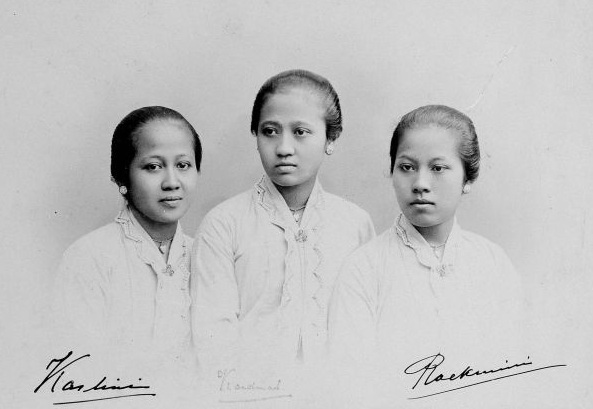
Suddenly a voice was heard from the depths of this unknown land. It rose from behind the high protecting wall that had done its work of subjection and concealment through the ages. It was gentle, like the melodious song of a little bird in a cage—in a costly cage it is true, and surrounded by the tenderest care, but still in a cage that was also a prison. It was the voice of Raden Adjeng Kartini, which sounded above the walls of the close-barred Kaboepaten. It was like the cry of a little bird that wanted to spread its wings free in the air, and fly towards life. And the sound grew fuller and clearer, till it became the rich voice of a woman.
She was shut in by aristocratic traditions and living virtually imprisoned as became a young “princess” of Java; but she sang of her longing for life and work and her voice rose clearer and stronger. It penetrated to the distant Netherlands, and was heard there with wonder and with delight. She was singing a new song, the first complaint that had ever gone forth from the mysterious hidden life of the Javanese woman. With all the energy of her body and soul she wanted to be free, to work and to live and to love.
Then the complaint became a song of rejoicing. For she not only longed to lead the new life of the modern woman, but she had the strength to accomplish it, and more than that, to win the sympathy of her family and of her friends for her ideals. This little “princess” lifted the concealing veil from her daily life and not only her life, her thoughts were revealed. An Oriental woman had dared to fight for feminism, even against her tenderly loved parents. For although her father and mother were enlightened for noble Javanese, they had at first strongly opposed her ideas as unheard of innovations …….
Raden Adjeng Kartini freed herself from the narrow oppression of tradition, and the simple language of these letters chants a paean “From Darkness into Light.”[2] The mist of obscurity is cleared away from her land and her people. The Javanese soul is shown as simple, gentle, and less hostile than we Westerners had ever dared to hope. For the soul of this girl was one with the soul of her people, and it is through her that a new confidence has grown up between the West and the East, between the Netherlands and Java. The mysterious “Quiet Strength” is brought into the light, it is tender, human and full of love, and Holland may well be grateful to the hand that revealed it.“
Today, Easter Sunday, I pray that the West can open its eyes to the Kartiniist glories which this website celebrates. These are glories which I believe the West and in particular Western feminism and suffering Western men badly need.
Some background:
The first wave of feminism, of which Kartini was a part, tackled the problem of liberating women from conditions like servitude. The second wave of feminism moved towards more equality and empowered women to much b=greater freedom in how they expressed and conducted themselves.
I have witnessed the third wave of feminism eliminate nearly all inequality disadvantageous to women. But huge parts of the third wave have also degraded mothers and hated men and elevated often dubious female victimhood to an article of faith.
I pray to Almighty God, the partner of Mother Earth in giving us this human home, that a fourth wave can restore a Kartiniist moral purity, free of disrepect for mothers, free of hatred of men and free from an over reliance of victimhood that poisons gender relations in the West now.
Raden Ajeng Kartini described human existence thus on August 17, 1902: “……. hoping, despairing, suffering and rejoicing, weeping and laughing; that is life.”
Lord God, let her inclusive, realist vision spread and prosper in the modern world,
Let it help resurrect the rights of men.
Geoff Fox, Easter Sunday, 2026, Melbourne and Ardeer, Australia